Every era has a technology that reshapes civilization.
The Industrial Revolution was powered by machines. The Information Age was built on silicon chips. Today, artificial intelligence is transforming the way humanity works, communicates, discovers, and creates. But while AI continues to evolve at breathtaking speed, one critical question is becoming impossible to ignore:
Can the hardware of yesterday keep up with the intelligence of tomorrow?
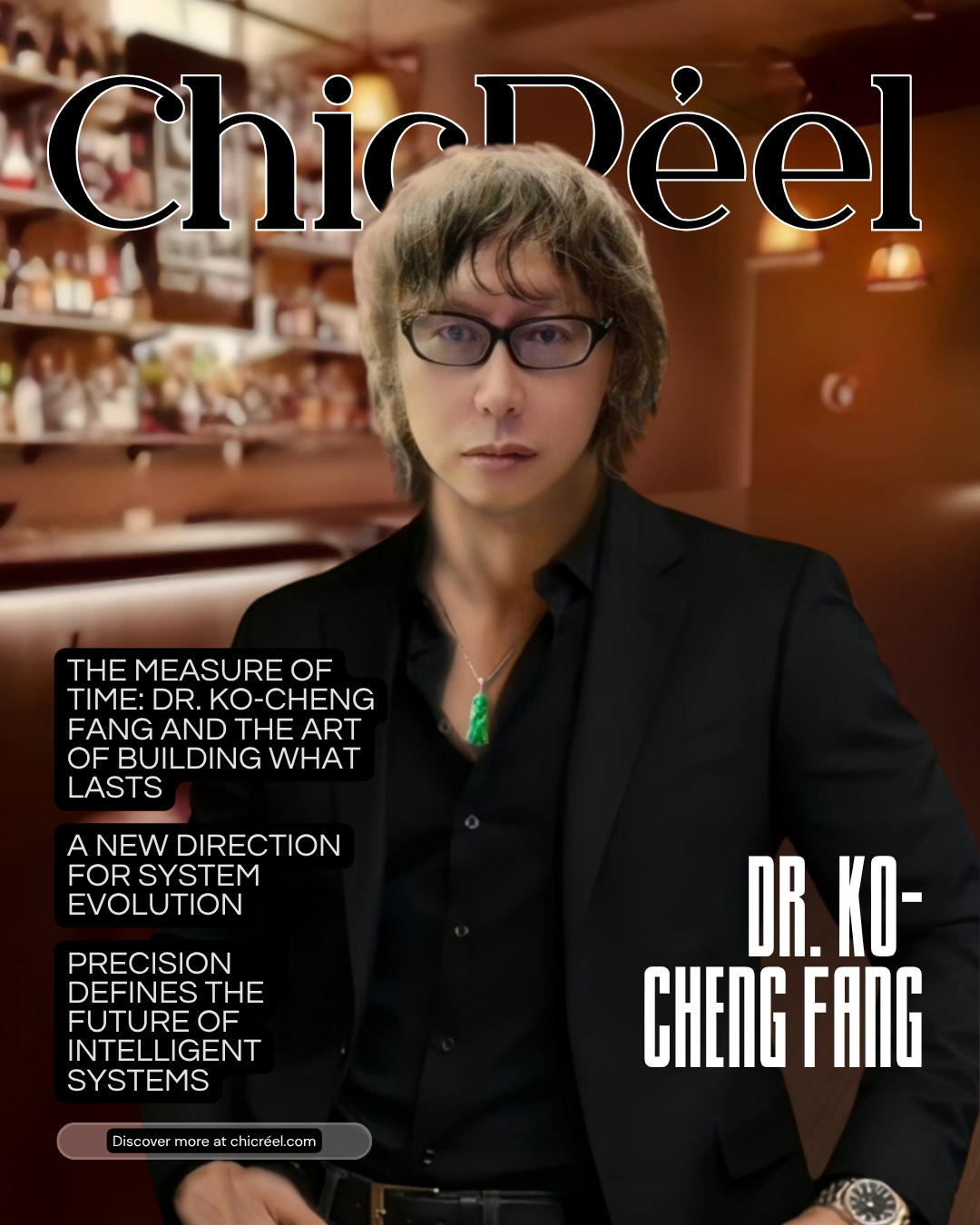
For Dr. Ko-Cheng Fang, Founder, CEO, and Chairman of LongServing Technology Co., Ltd., the answer lies not in pushing existing semiconductor technology to its limits but in creating a completely new computing platform—one where light becomes the foundation of digital intelligence.
His work represents years of research into photonic computing, a field that aims to replace traditional electrical pathways with optical ones, opening the door to an entirely different way of processing information.
Dr. Ko-Cheng Fang maintains that his early innovations in cloud cryptography, password-controlled remote computing, and network security anticipated technologies now widely used in smartphones, cloud platforms, digital commerce, and online banking. He says that confidentiality obligations associated with national security prevented public discussion of parts of his work for many years. Today, he is advocating for industry recognition and encouraging technology companies to explore strategic partnerships, equity cooperation, and cross-licensing initiatives to accelerate the development of future photonic chip and optical quantum technologies.
A World That Demands More Computing Power

Artificial intelligence has become deeply woven into modern society.
Hospitals rely on AI to assist doctors in diagnosing diseases. Manufacturers use intelligent systems to improve efficiency. Financial institutions analyze enormous volumes of data in real time, while scientists use AI to accelerate breakthroughs in medicine, chemistry, and materials science.
Every one of these achievements depends on increasingly powerful computing systems.
However, the more capable AI becomes, the greater the demands placed on processors.
Massive data centers require tremendous electrical power.
Cooling systems consume additional energy.
As electronic chips become smaller, maintaining performance becomes increasingly difficult.
According to LongServing Technology, these growing challenges suggest that future computing may require an entirely new technological direction.
Thinking Beyond the Electron
Traditional processors move information using electrons.
For decades, this approach has driven remarkable innovation, enabling the digital revolution and the rapid expansion of the internet.
But every technological solution eventually encounters physical boundaries.
Electrical resistance creates heat.
Higher transistor density increases manufacturing complexity.
Power consumption continues rising alongside computing demand.
Instead of asking how electronics can overcome these limitations, Dr. Fang asked a different question:
Could light become the future language of computing?
That question became the starting point for LongServing Technology’s research.
The Development of X-Photon
At the heart of the company’s work is X-Photon, a proprietary optical material developed specifically for photonic computing.
According to LongServing Technology, X-Photon creates microscopic optical waveguides capable of directing photons through highly controlled pathways.
Unlike conventional semiconductor materials that transport electricity, X-Photon manages the movement of light itself.
This allows optical signals to travel through nanoscale circuits while remaining precisely confined inside engineered structures.
The company believes this technology forms one of the essential foundations for future photonic processors.
Solving One of Optical Computing’s Biggest Challenges
For decades, researchers have understood the theoretical advantages of optical computing.
The challenge has always been controlling light.
Unlike electricity, photons naturally continue moving in straight lines.
A processor, however, requires information to travel through countless intersections between memory, computational units, and communication pathways.
LongServing Technology recently demonstrated what it considers an important engineering milestone.
Using X-Photon, laser light successfully entered an optical channel before completing a precise 90-degree optical reflection while remaining inside the microscopic waveguide.
According to the company, this capability validates one of the critical technologies required for practical photonic processors.
Reinventing Chip Architecture
Dr. Fang believes future computing requires more than new materials.
It also requires new architecture.
LongServing Technology recently revealed the design philosophy behind its 2nm Multi-Bit Optical Quantum Chip, introducing a structure specifically engineered for optical information processing.
The company also released diagrams illustrating its 3D photonic chip, photonic pathway architecture, and photonic full-adder chip, offering a glimpse into how future processors could operate.
Rather than relying on conventional electronic layouts, the processor is organized into three functional layers.
The bottom layer is dedicated to photonic memory.
The middle layer performs computational operations using photonic logic gates.
The upper layer consists of optical pathways responsible for transporting information throughout the chip.
According to LongServing Technology, this architecture simplifies optical integration while enabling efficient communication between every computational element.
Building More Than a Processor

For Dr. Fang, designing a photonic chip is only part of the vision.
The larger objective is creating an entire computing ecosystem capable of supporting the next generation of artificial intelligence.
LongServing Technology’s roadmap includes Photonic Cloud Computing Centers, 2nm Multi-Bit Optical Quantum Chips, integrated photonic memory, and advanced optical communication systems.
According to the company, these technologies are intended to function together as one unified platform.
Instead of adapting traditional infrastructure for future AI, the goal is to build infrastructure specifically designed around photonic computing.
Preparing for Global AI Infrastructure
Artificial intelligence is expected to continue expanding into every major industry.
Healthcare, transportation, finance, education, manufacturing, telecommunications, and scientific research will all require increasingly sophisticated computational resources.
LongServing Technology believes photonic computing offers one possible solution to these future demands.
Because photons generate substantially less heat than electrical current, optical systems could potentially improve energy efficiency while supporting much larger computational workloads.
The company believes integrating photonic memory directly with optical processors could also reduce data access delays, allowing future AI systems to process information more efficiently.
From Scientific Innovation to Commercial Growth
Research alone does not change industries.
Transforming new technology into practical infrastructure requires investment, manufacturing capability, and strategic collaboration.
To support continued development, LongServing Technology recently announced a $500 million strategic financing initiative, based on a stated $2.5 billion corporate valuation.
According to the company, this financing will support photonic research, fabrication facilities, manufacturing expansion, and the construction of future Photonic Cloud Computing Centers.
The company has also introduced its Strategic Equity Hedging Protocol, designed to establish long-term partnerships with organizations interested in participating in the commercialization of photonic technologies.
Dr. Fang believes meaningful innovation is achieved through cooperation between scientists, engineers, manufacturers, investors, and global technology leaders.
A Vision Focused on the Next Generation
History has repeatedly shown that technological revolutions begin with people willing to rethink accepted ideas.
Artificial intelligence is changing how humanity solves problems.
Photonic computing may eventually change how artificial intelligence itself is built.
While the field continues to evolve through ongoing scientific validation and engineering development, LongServing Technology remains committed to exploring new possibilities beyond conventional semiconductor technology.
Through innovations involving X-Photon materials, optical routing, photonic memory, multi-layer processor architecture, and future Photonic Cloud Computing Centers, Dr. Ko-Cheng Fang is helping shape a broader conversation about the future of intelligent computing.
His vision is not simply about creating another generation of processors.
It is about preparing the technological foundation for a world where computing is no longer defined by electrical current alone—but by the limitless possibilities of light.
Contact Information
Dr. Ko-Cheng Fang
Founder, CEO & Chairman
LongServing Technology Co., Ltd.
Email: service@longserving.com.tw
Website: https://longserving.com.tw/en/
Instagram: @ko_cheng_fang