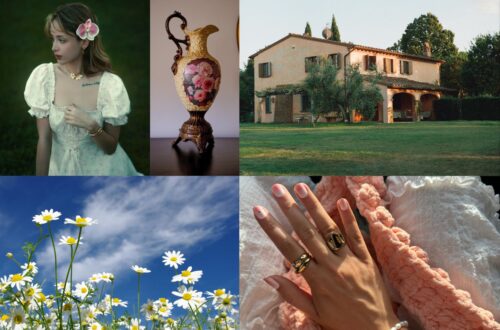
In a world overflowing with visual noise — trends changing at the speed of a scroll, influencers prescribing what’s “in,” and algorithms telling us what to wear — finding your own aesthetic style feels almost radical.
But here’s the truth: personal style isn’t discovered in one click or one closet overhaul. It’s an evolving language — one that speaks through colors, textures, moods, and choices that feel uniquely you.
Whether you’re curating your wardrobe, your home, or your Instagram feed, your aesthetic isn’t just about how things look — it’s about how they make you feel.
So, how do you truly discover your personal aesthetic style? Let’s begin.
1. Begin with Feelings, Not Pinterest Boards
Before you open Pinterest or scroll through aesthetic hashtags, pause.
Close your eyes and ask: How do I want to feel every day?
Do you crave calm and minimalism — a sense of air and lightness? Or do you feel alive in maximalist spaces filled with color, texture, and story? Do you lean toward the romantic, the modern, or the nostalgic?
Your aesthetic begins with emotion. The goal is not to copy a visual theme but to express how you want to move through the world.
If you want to feel serene, your aesthetic might lean toward neutral tones, open spaces, and soft fabrics.
If you want to feel bold and creative, your palette may lean into contrast — rich reds, deep blues, sculptural silhouettes.
Aesthetic discovery begins where emotion meets intention.
2. Look for Patterns in What You Already Love
Your aesthetic often reveals itself through repetition. You just need to notice it.
Take a quiet hour and scroll through your saved images, screenshots, or things you’ve bought and loved for years — clothes, décor, even movie stills.
Ask yourself:
- What colors repeat?
- What textures draw me in — linen, metal, wood, silk?
- What kinds of spaces or outfits make me exhale?
You’ll start to see a pattern — maybe it’s the softness of natural materials, the symmetry of clean lines, or the playfulness of color.
This isn’t about what’s fashionable; it’s about what feels familiar. Those patterns are clues to your authentic aesthetic.
3. Define Your Anchors: Color, Texture, Mood
Every personal aesthetic can be built around three anchors: color, texture, and mood.
Color
Choose 3–5 shades that feel most like you. They could be neutral (cream, taupe, gray) or emotional (terracotta, olive, blush, black).
These colors will ground your wardrobe and interiors, creating consistency across your visual identity.
Texture
Texture adds soul. Do you gravitate toward crisp cottons and steel finishes, or toward soft knits and warm woods? The materials you prefer reflect your emotional palette.
Mood
Finally, define your mood in three words. For instance: elevated, serene, natural — or bold, urban, cinematic.
Every object, outfit, or photograph you choose should align with those words.
The combination of these three anchors is your aesthetic blueprint.
4. Find Inspiration — But Interpret, Don’t Imitate
There’s nothing wrong with seeking inspiration online — it’s how most of us discover what we love. The key is to use references as mirrors, not maps.
When you look at an image that speaks to you, ask why you like it.
Is it the lighting? The shape? The mood? The story it tells?
Break it down. Take that essence and translate it into your own world.
Maybe you love the “Parisian chic” aesthetic — but instead of copying berets and stripes, you might translate its spirit of effortless elegance into linen blazers, simple gold jewelry, and undone hair.
Style isn’t about replication — it’s about reinterpretation.
5. Curate Slowly — Style Evolves with Time
We often mistake aesthetic identity for something that must be defined immediately. But true personal style is slow, intuitive, and forgiving.
You don’t have to purge your wardrobe or redecorate overnight. Instead, edit gently.
Start by removing what feels wrong — the colors you never wear, the décor that drains you, the patterns that feel loud. Then, make space for what resonates.
Buy less, choose better. Let each new addition earn its place in your life. Over time, you’ll notice coherence — a rhythm between your fashion, your home, and even your lifestyle choices.
Your aesthetic becomes visible when you start living intentionally.
6. Express, Don’t Impress
Your aesthetic isn’t a performance. It’s an expression.
There’s a fine line between creating a look that feels authentic and creating one that seeks validation. The moment you start choosing things to “fit in,” you dilute your aesthetic’s power.
Instead of asking “Will people like this?” ask “Does this feel like me?”
Wear the coat that feels like a hug. Decorate with art that makes you think. Choose lighting that calms you at night.
Authenticity is magnetic — it always stands out.
7. Accept Evolution as Part of the Aesthetic
The biggest mistake people make? Thinking their aesthetic must stay the same forever.
But you’re evolving — and so should your style.
As your life shifts, so will your needs, colors, and forms of expression. What once felt right might feel heavy later, and that’s not inconsistency — that’s growth.
Style isn’t a static identity. It’s a mirror of your current truth.
8. The End Goal: Harmony, Not Perfection
At its heart, your personal aesthetic should make your world feel cohesive, not curated.
When your wardrobe, workspace, and surroundings echo your inner rhythm, life starts to flow differently. You dress faster. You decorate intuitively. You feel at ease.
That’s when you’ve found it — the aesthetic that doesn’t need explaining. It simply feels like home.
Final Reflection
Discovering your personal aesthetic style isn’t about becoming someone else — it’s about uncovering who you already are, visually and emotionally.
It’s less about trends, more about truth. Less about being seen, more about being felt.
So take your time. Edit your space. Dress with intention.
Let every choice — from the scent you wear to the cup you drink from — reflect your essence.
Because in the end, your aesthetic is not a look.
It’s a lifestyle — one that feels beautifully, unapologetically, and deeply you.